content/inhalt


- vorwort bzw. grundsätzliches zum wort/erklärungsanspruch an das bild
- a short guide for the construction of meaning, elisa oddone

- architektur des beweises (p5), ludger schwarte
- from the exterieur to the interieur, matthias harder
- die vertiefung des alltags, matthias harder
- the anatomy of surface (p4)
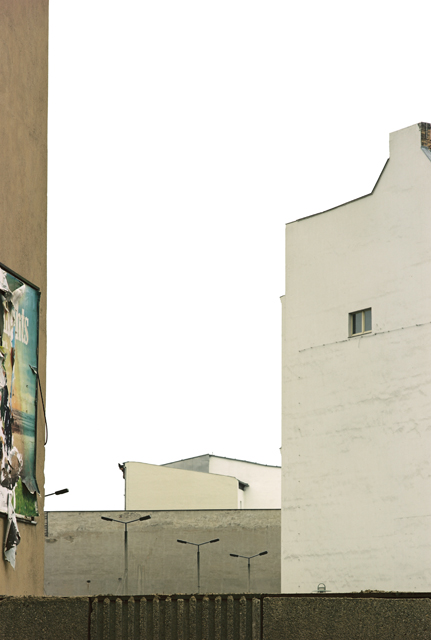
- brandwände/fire walls (p6)
- akademie der attrappe (p3)
- berlin:portrait, matthias harder
- vor der haustür (p29), jürgen brömmer
- abstandsgrün und lebensraum (p29), eva-maria kaufmann
- das ende der kreidezeit (p8)
- d-konstrukt (p9)
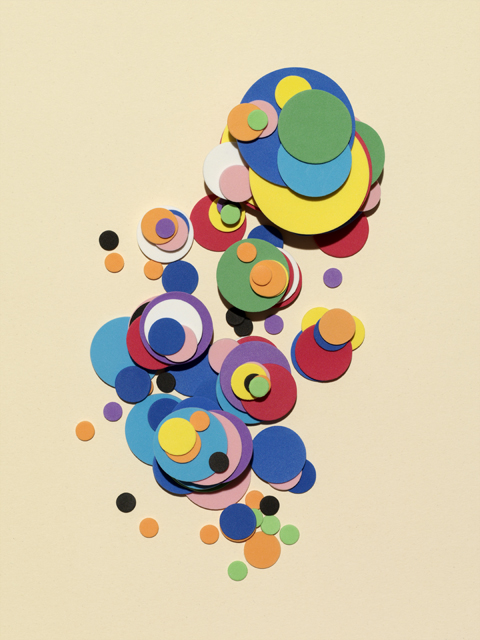
- clusters/korruption des zufalls (p39+40)
- genetic decompression vs. mondrian (p35)
- photomatique/visual programming language (p41, p42)
- piktogrammstudien (p33, p43)
- photo kinetik (p6, p37, p38, p44)
- the fiction of science (p47)


vorwort (frank hülsbömer)

es werden von mir immer wieder aussagen zu den arbeiten verlangt. diesem anliegen kann immer nur in teilen nachgekommen werden, weil die brücke zwischen unbewusstem u bewusstem nicht in jedem fall begangen/überquert werden kann. manchmal auch gar nicht, falsch oder nur als vermutung/versuch. erklären sie eine melodie! erklären sie die herkunft eines gedankens! erklären sie den sinn von emotionen!
auch in der geschichte der „philosophy of mind“, in der quasi professionell um antworten auf diverse phänomene und fragestellungen gerungen wird, wird man bis zum heutigen tag nicht in der weise fündig, dass sie befriedigend oder endgültig oder gar absolut beantwortet wäre. ganz im gegenteil. alles kann immer (und wird immer wieder) widerlegt werden. was bleibt, sind die fragestellungen. die wahrheit - eben weil die frage keine solche verspricht und somit nicht widerlegt werden kann - liegt in der frage, dem phänomen, dem erscheinen an sich. ich bemühe mich kluge fragen zu stellen und sie scheinbar vage zu halten bzw. offen zu formulieren, weil in der rhetorisch angelegten frage schon wieder die antwort bzw. aussage liegt, die ich nicht treffen kann. diese manipulationspolemik (wie eine forschung, deren ziel bereits feststünde, also keine forschung mehr wäre) brächte eine nicht zu verantwortende unanständigkeit (wie wir sie im alltagspolitischen ständig erleben) mit sich. in diesem sinne sind viele meiner bilder vor allem fragen. zugegebenermassen ästhetisierte fragen, damit die betrachtung nicht wehtut aber auch als ausdruck einer ordnung, die wir in uns vorfänden, würden wir nicht ständig davon abgehalten und abgelenkt. meine bilder wollen in diesem sinn pur, klar, entmystifiziert und einfach sein, um einer sinnvollen komplexität vorschub zu leisten.


--------------------------------------------------------------------------------------------------------------


A short guide for the construction of meaning. text by Elisa Oddone for the exhibition at WiE Kultur berlin 2011
Can geometrical forms be something else from what they actually are? If yes, could they serve as basis for a new vade mecum apt to instruct us on how to construct meaning? This last question is the leading theme of A short guide for the construction of meaning, the exhibition presenting the new works of Berlin based artist Frank Hülsbömer.

Using photography and video as art media, Hülsbömer depicts a parallel universe inhabited by minimally structured surfaces and forms in which all contradictions are admitted and – sometimes - happily unified. The artist's way of treating objects is both poetical and playful: it seems as though he is taking a step back in order to allow his objects to live and to develop their own life (tennis speed of light, decelerating flashmob, how B became A).Hülsbömer does not want to disturb the scenery he is looking at. Indeed, it appears as if the artist has just limited himself to the mere observation of the aesthetic scene he is in front of and then named it by taking recourse to his elegant and characteristic sense of irony.

The importance of the playful experience and of the natural development of the state of affairs is one of the fundamental features in Hülsbömer’s art. As the artist himself explains: “When I was a child , I used to pick up my father at work. At the time he was working in the building of the West LB in Münster. This building, erected during the 60s by architect Dahlmann, and surrounded by a big park, is known for its big modernist art collection. While I was waiting for my father to come, I spent my time playing, jumping and daydreaming in this exciting and magical space. Today, when I reflect about it, I come to the conclusion that I was very lucky to have had my first encounter with art in this unpedagogical and unostentatious way. Art should primarily be presented in such a way instead of being preceded, as it often happens in museums due to their intrinsic nature, by a sort of announcement reciting: Attention! You are in front of an art object!”
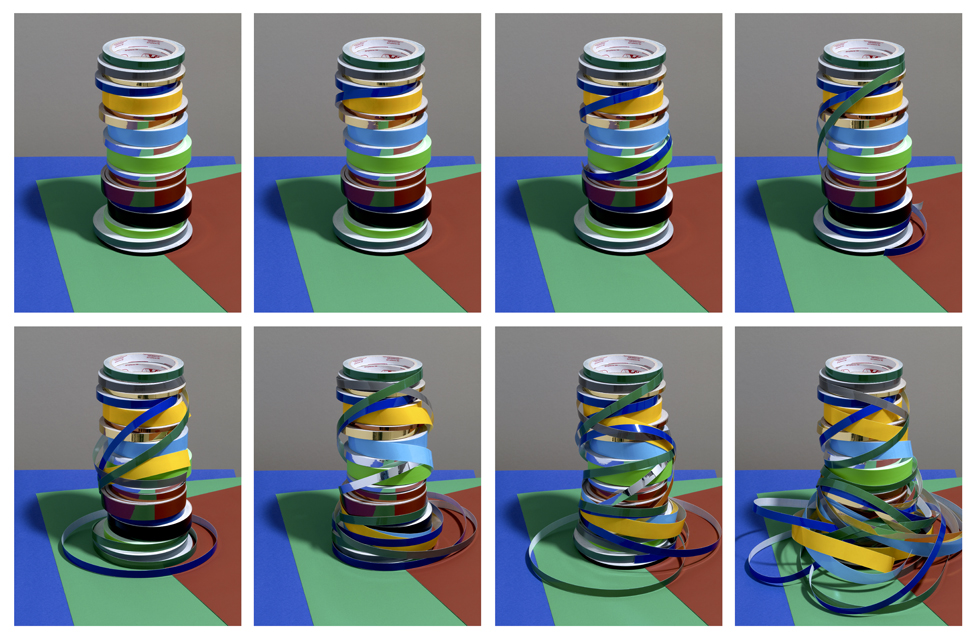
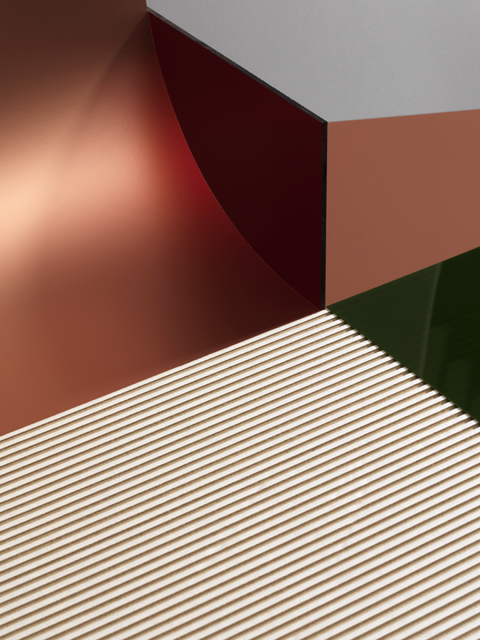
If, on the one hand, the playful experience is a central point in Hülsbömer’s work, on the other, it is unavoidable not to be struck by his rigorous and clean mannerism. At first sight, Hülsbömer's dynamic depictions of objects can arouse suspicions of just being computer renderings or 3D computer graphics. However his work surprisingly is subject to no other intervention except for the pure instrument of photography and the simple act of filming.

Due to the clarity and minimalism of the work and the artists striking virtuosity of photographic technique, the viewer is led to think that Hülsbömer wants to reach a sort of visual perfection. Hülsbömer himself says that there is no attempt of portraying perfection in his work: “Perfection is just an idea, which people can only aim at.” Hülsbömer is attempting to demystify and simplify the phenomena of reality through a continuous reference to the dualism permeating our human experience.

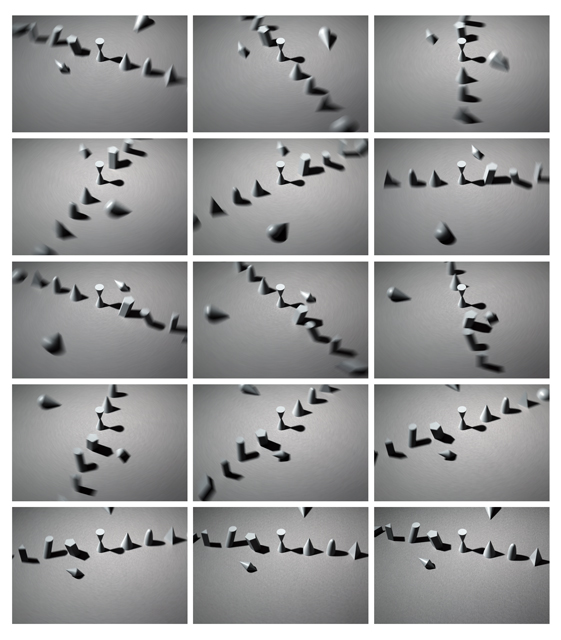
In this attempt of simplification and demystification one is able to recognize a connection between Hülsbömer’s work and the artistic production of the group active in Germany during the `50s known under the name of Subjective Photography. The photographers belonging to this movement - Peter Keetman, Wolfgang Reisewitz, Otto Steinert and their students - were interested in pursuing a visual purism obtained through the exercise of formalist imagery. Otto Steinart describes features clearly recognizable in Hülsbömer’s work: “The photographer transforms the motif by creatively intending the world throughformalreductionsthatplace out-of-frame the everyday presentations of reality, defamiliarizing that world and reconstituting it at a deeper level of personal perception that is realized in new types of formal ordering”. Hülsbömer’s demystification of reality follows those lines and achieves the absolute photographic creation mentioned by Steiner in which “the subject is defamiliarized to such an extent that it remains only as a formal armature of the construction of the image’s geometry”. Hülsbömer gives the results achieved within the Subjective Photography a new twist. This is made possible by the very personal interpretation of the media used to portray the geometric shapes by the artist who is not bound to the mere use of photography but crosses over to video art achieving a further fragmentation and reduction of the represented objects. Hülsbömer's original use of Photokinetiks, reminding the viewer of a zoetrope, in which the illusion of action comes from a rapid succession of static pictures giving the impression of a “vision held in suspension”, points out the change of the current state of affairs within the scenery intended by the artist as a metaphor for the human condition. Hülsbömer’s Photokinetiks has a narrative value that, although detached from the perceptual world and characterized by an extreme simplification, allows the spectator to reach a deeper understanding of reality which appears lyrical in its elementariness.
Realism and representation, chance and science, movement and calm, a playful and a rigid way of representing objects, light and shadow are the sort of dualism recognizable in Hülsbömer’s estranged world.

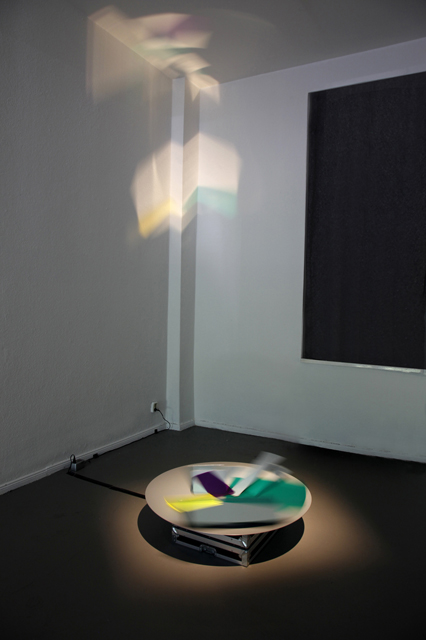
A short guide for the construction of meaning focuses on the strong tension between chance and science. This is a recurring theme in Hülsbömer’s work, already present, indeed, in his book The Fiction of Science. However, in his new work the artist shows an enhanced and matured treatment of the topic, which reaches a full-fledged mastery in works, such as Wheel of fortune. The balance offered by the rotation of the geometric shapes puts us in front of the fact that, whether the obtained combinations are merely a matter of chance or the result of a rigid calculation of probabilities, it is, in the end, solely a different perspective of observation. The movement of the objects might ultimately remind of the revolution of a hypothetical planet system explicable through physical calculations and scientific theories, which are - in the end - based on the analysis of pure forces instantiated by an innocent combination of chances. Where are the bounds between science and chance to be set? Do they exist in a pure form or do they rather constantly overlap? Those questions constitute Hülsbömer’s mantra, who now, from his agnostic altar, seems to have discovered an aesthetic golden rule capable of serving us with those answers through the representation of a happy reconciliation of opposites.
The objects represented in Hülsbömer’s work are aesthetically disconnected from the world. This choice of presentation puzzles the spectator who, once faced with his works, has no idea how big or what the objects represented are, because the artist does not provide (or, more correctly, does not want to provide) him with any objective scale of measurement. Indeed, Hülsbömer’s universe exists, functions, develops and plays in its own peculiar dimension without any dimensions. This is a context in which, again, Hülsbömer’s scientific fascination is evident by offering an attempt of a concrete application to theoretical physical insights.

The importance of science in Hülsbömer’s art originates from his interest toward the language of mathematics, particularly from the work of the mathematician and philosopher GottlobFrege (Begriff, Funktion, Bedeutung). “I compare arithmetics to a tree that unfolds upwards in a multitude of techniques and theorems while the root drives into the depths”, claims the German philosopher and Hülsbömer continues this statement, trying to discover what these depths actually are and by offering an aesthetic portrayal of the techniques and theorems characterizing their nature. Could those unknown depths offer us an ultimate meaning? Borrowing from Frege Hülsbömer's works investigate the areas of sense and meaning, establishing a playful relationship with them: Can it be possible to find an unchangeable rule that allows humans to construct meaning? Is Hülsbömer inpossession of it? The elegance, balance and minimalism that characterize his work seem to answer positively.


--------------------------------------------------------------------------------------------------------------


schriftzug
Conversations with Frank Hülsbömer
 
Our 6th Kabinett Termin took place on March 24th. This time speakers included Frank Hülsbömer (artist), Elisa Oddone (guest curator), Prof. Philip Percival (University of Nottingham) and Prof. Ludger Schwarte (Kunstakademie Düsseldorf).

...........................................................................

The artist about his works
 
constructing meaning in 3 steps

“On the one hand it’s about the struggle to constructing meaning as an artist with whatever he does. But of course it’s also about the ironic side to it – the struggle that we have in finding and constructing meaning.
The word ‘guide’ also comes from the “Hitchhiker’s guide to the galaxy” by Douglas Adams where earth is considered to be a computer that is supposed to find the questions to the most important questions. So the title and the picture have a link to this struggle.“


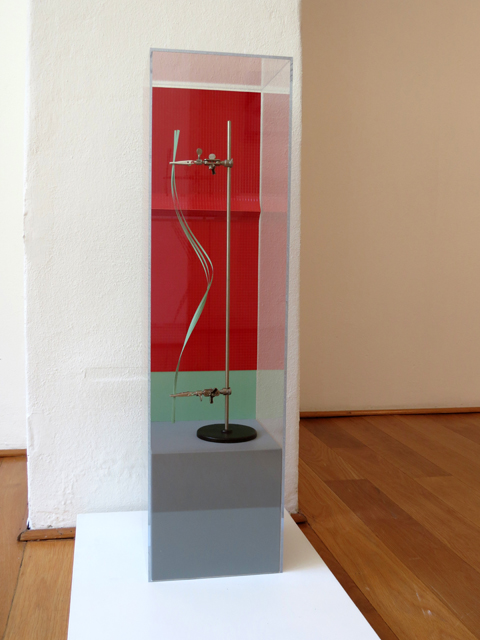
agnostic altar

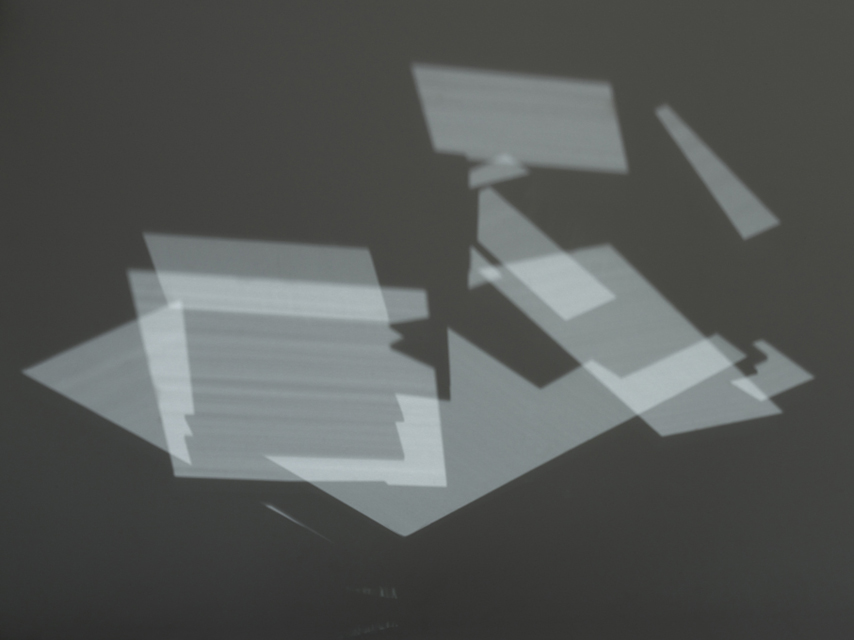
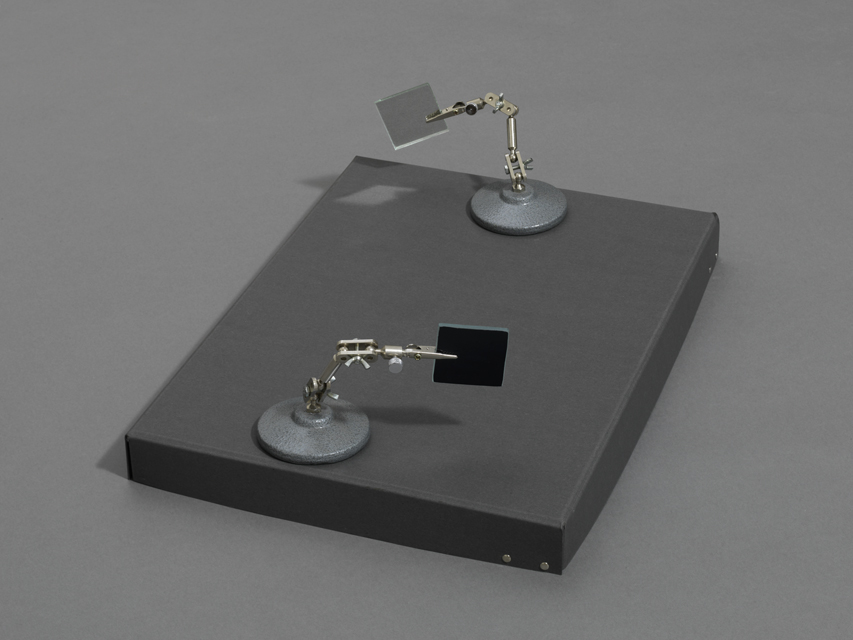
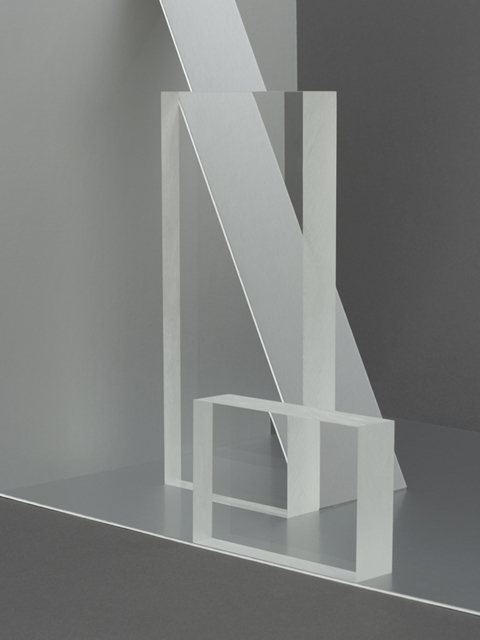
“Altar suggests something mysterious, although in this picture everything is meant to be logical. The way the light works is purely physics and logic. The grey part is just doubled and they have this foil that works like a mirror. I let a lamp shining into it, and the reflections would go on this wall.
So what’s happening is: when you see the reflections of the light that is going through the mirrors and on the board, in the middle they are more squarish, and then departing from the middle becoming more and more round. It seems to be like mysterious or something unexplainable, but it is due to the fact that the mirrors are like lenses. In the end you have the image of the bulb. It maybe looks like something mysterious is happening but it’s just clearly physics.
And to the colours: They are made on the computer at the one side. The grey was the original. And the other side is re-coloured. This is pretty much the only one, which has such a strong Photoshop influence.”


the quarter revolution

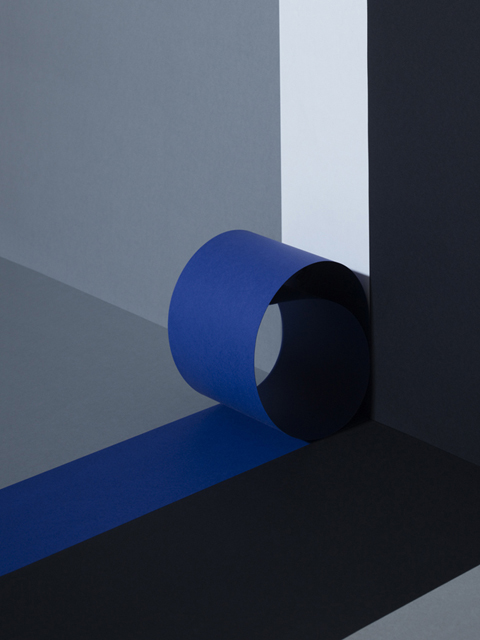
“It reminds a little bit of big revolutions, like in Africa or the French revolution, but also personal revolutions in terms of personal development. We never get the full 360 degrees.”


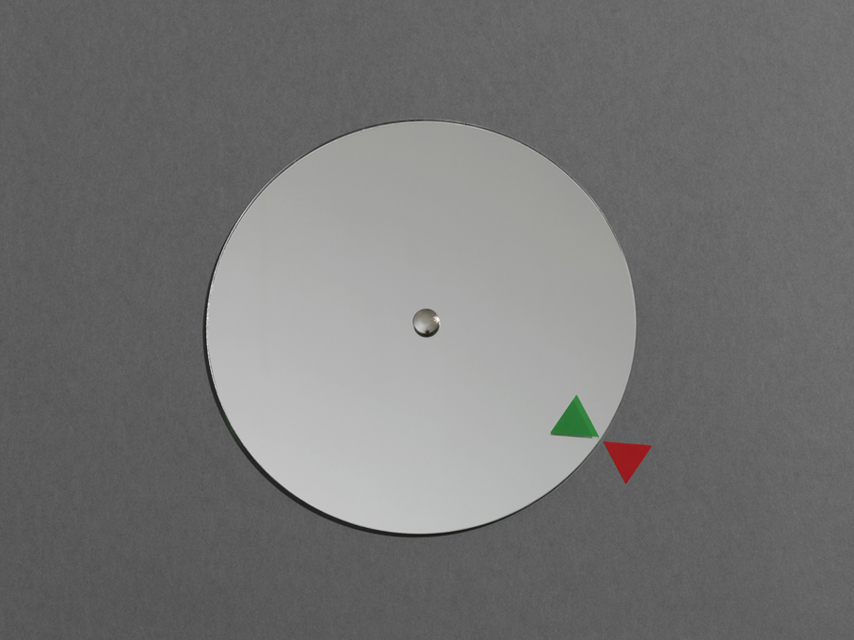
disposition

“It is technically a mirror. There is this circle, which is turning and indicated by the green arrow. It just turns once around, and ends up in the same spot. Something is turning, but nothing is changing. Plus, the disk is a mirror, but the reflection never changes.”


how  b became a 

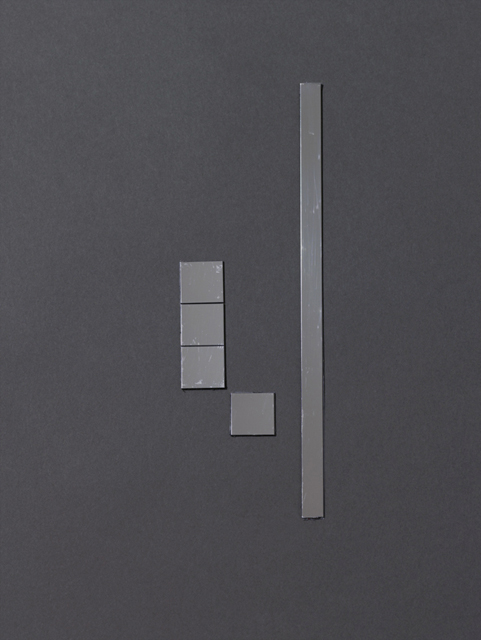
“It’s from the language of mathematics like Gottlieb Frege might have developed it. It brings some lightness into the mathematics, it’s an alternative way to how B can change its position to become A. It’s just moving over A.”


the tennis speed of light
 
“It’s intentionally like this: I mean, you cannot play tennis by the speed of light, although I’m suggesting it here. Chen Yang calls it ping pong.”


without title
 
“This one doesn’t have a title yet. Sometimes the titles come later, much later, when I start to understand my work as I work a lot subconsciously. So sometimes it just needs development. It’s also about coincidence. On the other hand I’m already manipulating the coincidence in these pictures. So it’s really a mix with my other series in my book The Fiction of Science, called “The corruption of chance” where people are supposed to doubt if it is accidental, coincidental arranged. “


decelerating flashmob
 
"I was hoping that Jan Lazardzig, the theatre scientist would come and could tell us something about “performance of objects”. For me it has something of a theatre performance. You also have this in the catalogue; I have set it up with the single objects, some kind of alphabet of symbols or signs. This piece came in the catalogue where symbols get coincidentally matched, and you develop phrases or sentences.  And where all symbols come together, they start to make sentences or even sense.This stage, for me, is more like a sketch with those symbols or signs coincidentally being combined with each other. So they are not linked with each other the way you would always get the same combination again."


...........................................................................
 

The discussion (excerpts)

 
Ludger: Do you make drafts before you shot your series?
Frank: I didn’t do it with these.
Ludger: